The Plan
In this section of the site I hope to gather as much material as
possible associated with the version of the Railway Rivals
published privately by David Watts, the game's inventor, together
with the many maps produced by the game's enthusiasts, often
for postal play. If your interest is limited to face-to-face play on
a version of the game that mimics that published by Games
Workshop in the 1980s, then a visit to
RailwayRivals.co.uk
is recommended.
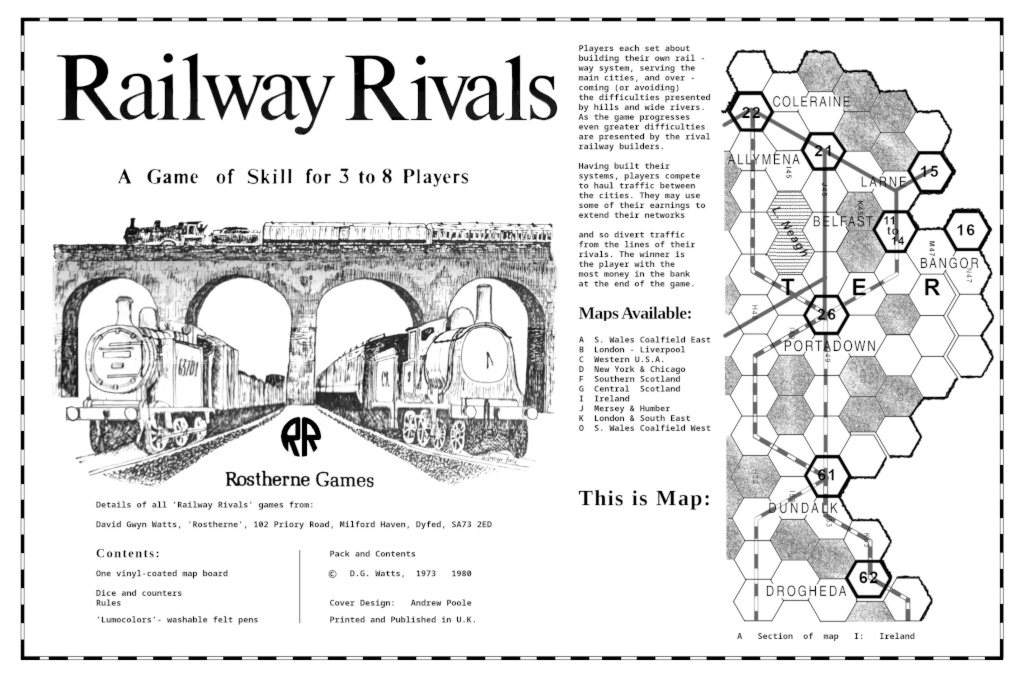 An approximate reproduction of the label you found wrapped
around the tube containing the game you ordered from David
Watts.
The "RR Archive" project was conceived when I found that some
of the sites that hold relevant information appeared to have been
abandoned or offered no way to contact the owner and I feared
they might go off-line without warning. By good fortune Richard
Smith, who was the first person I attempted to contact, put me
in touch with a number of people still active in the postal hobby.
All of his contacts proved very supportive of the project and I
thank them for helping to seed the archive.
Further Help is Welcomed
I was not a close confidant of David Watts, just an occasional
customer with a love of the game. I would welcome
contributions of any material that you might have. This could
be earlier and later editions of the rules and any of David's
catalogues and price lists currently missing from the archive.
Indeed, any further background information or history you have
and may not have turned up in my own internet searches. You'll
note the list above does not include maps. I address the question
of Maps below.
It is my understanding that all material submitted to the site
has been donated on the basis that the owner's permission
has been granted. Please contact me
if you own the copyright and wish it to be withdrawn.
The Tube and Miscellaneous Components
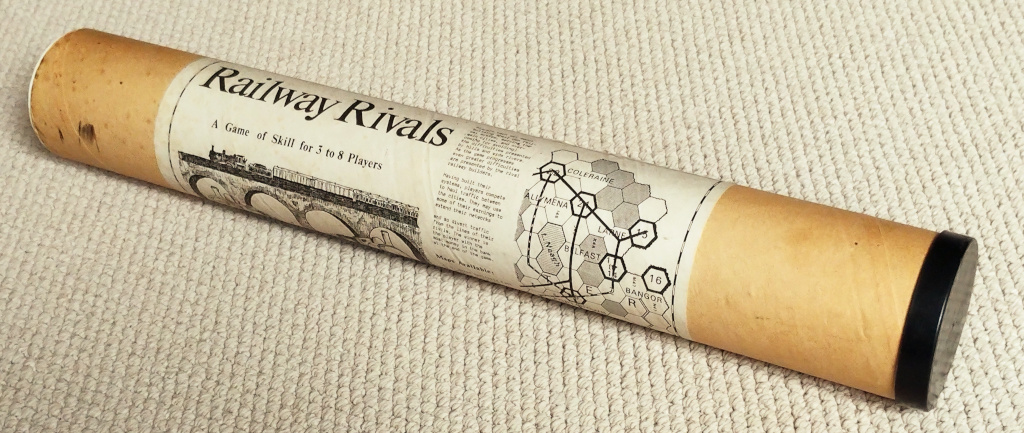 The game was mailed to you in a 50cm long by 75mm
diameter cardboard tube with 5mm thick walls. It had a
glued on monochrome label with a black outside cap at one
end and a white inset cap at the other.
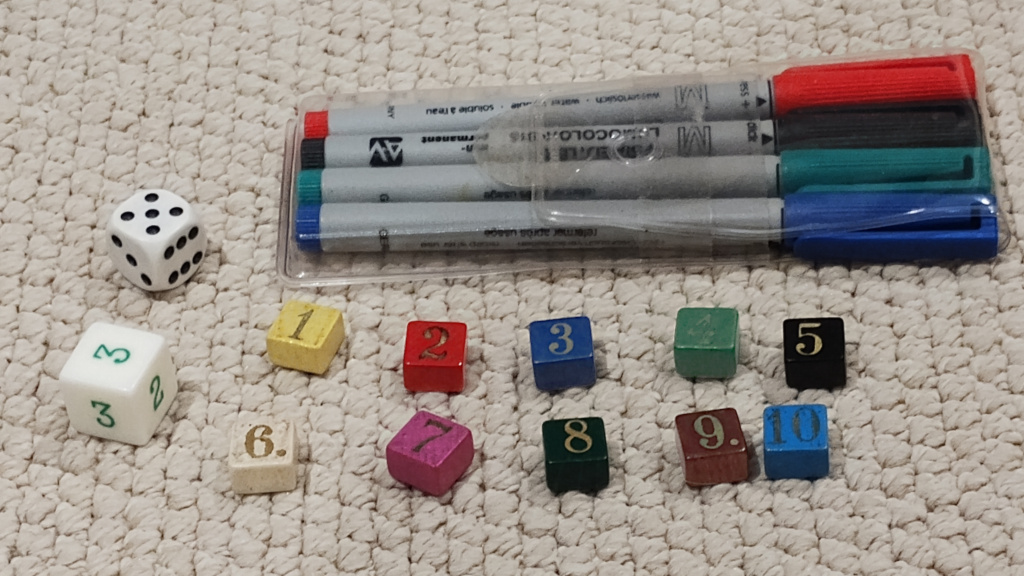 The pens counters and dice that came with the game as
supplied by David Watts.
The tube that David would send to customers contained a pack
of four Lumocolor non-permanent pens, a standard die, a special
die that replaced the sides marked 1 and 6 with additional 3 and
4 faces, and a set of wooden playing pieces. Until about 1984
these were square and numbered 1-10 in gold.
However the 1985 catalogue refers to "Halma
shaped" counters being available as spares. It is not known when
this type of counter began to be supplied with a game or how many
were supplied, but the catalogue does say that 8 colours were
available, so until firm evidence is provided I would assume that
was the number included in any game purchased.
Beside the one or more maps that would have been ordered by
the customer the tube also would contain two A4 sheets, one
a closely typed rule sheet and the latest
catalogue and price list describing
the latest maps available for Railway Rivals and, in later editions,
the other games he had invented.
The Maps
At this point, I have not decided on the best format to adopt for
maps. It's forty years since I was active in the postal games
hobby and since then I have only played RR face- to-face a
couple of times. Now there are home computers and the Internet.
A format is needed that, perhaps optionally, allows hex
references to to appear on a map to aid those playing remotely,
while also being able to produce a crisp image of a map up to
A2 size, for convenient face-to-face play. The blank hex sheets
that David Watts used to produce measured an even larger
64cm x 45cm. Will anyone want a PDF file that
they can take to a commercial printer? How many have A3
printers at home? Will people be willing to stitch together a
number of A4 sheets to play a game? Until a decision is made,
and everyone visiting the archive is invited to
express a view. In the meantime I
recommend a visit to the excellent and well maintained
Map Collection maintained by Lars “Issu” Olsson.
The Rules
To download the rule sheets click/tap on either the thumbnail
image or heading. These will normally be PDF files of scans
of the printed versions supplied in the cardboard tube,
although in some cases David's original WORD .doc files may
also be available.
For Face to Face Play
These were printed in fairly small type with copyright
dates 1973, 1976 and 1980, which presumably gives us
the dates of the earlier two editions, yet to be acquired by
this archive. The opening words of the short Introduction
section say, 'There are over a dozen versions of "RR"'.
Following the Introduction the rules are divided into a
number of lettered sections. These are:
- The railway building stage
- The Railway operating stage
- Variants
- Starting Towns
- Amendments and special rules
- Other points
As might be expected, sections D-F cover rules for
special cases on specific maps and revisions needed
to others. Perhaps more surprising are that the maps
are referred to as "boards" in places and, if you are
unfamiliar with the postal games scene of the period,
you might not expect to be invited to ring the inventor
about rule interpretation.
The Sixth Edition was issued in April 1990. The version
here is the March 1994 reprint, which has minor changes
to rules B1e and C3. The illustrations are changed to
better illustrate the costs of line building and the main
sections are now headed:
Introduction
Components
Preparation
- The Building Stage
- The Operating Stage
- Optional Rules
Notes
Overall there is a lot more content so the type
used is still smaller than that in the Third Edition. This has
led to a two column format to reduce the numbers of words
per line and make it easier to read.
The preamble is extended to include a more detailed
description of the game, saying the game is for 3-6 players,
in contradiction to the label on the tubes in which the game
was supplied.
The notes at the end include a brief history of the game,
mentioning the various commercial editions and naming
contributors to the fifth edition of the rules. They also report
that there are about 20 "official" maps, and about 30
experimental half size maps, some of which will become
official later.
For Postal Play
The download in this section was created from a .doc file,
believed to have been created by David Watts and circulated
through the postal hobby over a number of years.
The opening paragraph of these rules states "These are
mainly based on 6th edition normal rules (1994). ... These are
the rules for normal maps, with 36 town and 6 special key
numbers. Some may need to be amended for those with
more or less than these 42 numbers". There follow four
sections:
- General
- Building Stage
- Operating Stage
- "Economic" Rules
NOTE: I am still to determine the date when the first maps
were introduced that had more than the original format of towns
fitting the dice-throwable 11-66 and 6 special runs format.
They are referred to in the standard 6th Edition rules, but
they could have first appeared as the 4th or 5th edition rules
were published.
Catalogues and Price Lists
It is not known if there was a regular cycle of David's games
catalogues. It appears that they were produced spasmodically
as they went out of print or out of date, so those offered here are
unlikely to be a complete set. The downloads available in this
section have mostly been generated from poor quality photographs
or scans of the original documents.
The June 1983 edition was scanned from a David Watts'
type-written print and then the text extracted using an AI tool
before being manually corrected to re-introduce all the oddities
of indentation, spacing, spelling and underlining of the original
document. For example, it appears the address in the top left
corner was typed separately from the rest of the document as
it has a separate alignment on the original, not captured in the
download version.
The January 1984 document was created from an ill-lit photograph
found on eBay of a crumpled original held down at the corners by
cups. The original appears to have been produced by a professional
printer as in 1984 only dot matrix and daisy wheel printers were
available for home computers and these did not allow for the variety
of font size, weight and style seen in this edition. Some perspective
editing and colour correction was done before it was submitted to
an AI tool. An .otd file was requested and, eventually, a font found
that appears to match the original. The result is a file that is only a
close representation of the original. The original appears to have
some unusual spacing that can't be easily reproduced by a word
processor. I hope to find the time to re-work the file with a DTP
program to get a better result.
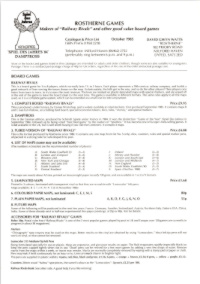
The October 1985 document was supplied to me as a pair of PDF
files of scans of very yellowed originals that showed a shadow of
the other sides of the page. I have been able to clean them up.
However, they remain as images, so the text within them is not
searchable as it is with the others that have been more heavily
processed.
Unlike the later catalogues in this collection, this one was
clearly specifically designed to be provided to a new buyer of
a game, rather than someone with a more general interest in
Rostherne Games. For example, uniquely, it's opening words
are "This tube should contain the following components:"
This issue is also the only edition to mention "The Rostherne
Games Review", David's magazine in which subscribers would
help test some the new variants and games on which he was
working. However, in this issue of the catalogue you get no
clue about what was in the pipeline.
The bulk of the content is a combination of advice on the
use of the Lumocolour pens, the game spares the other
materials available, and news of the maps currently available
or planned and the best numbers of players for each.
Seven months after the previous edition of the catalogue
this one is rather different. Gone is the text that suggests the
catalogue will only be sent out in a tube accompanying a game.
In this edition you find the following headings:
- SERIES 1: RAILWAY RIVALS
- SERIES 2: BUSINESS GAMES
- SERIES 3: STRATEGY GAMES
- HEXAGON SHEETS
- TRANSPARENT SELF-ADHESIVE VINYL
The range of games other than Railway Rivals, promised in
the previous edition, appear for the first time. The final two
headings also offer new items not previously sold separately.
However, gone is any reference to the Rostherne Games Review,
David's house zine. Also missing are items such as Lumocolor
pens and counters. That is most likely because there was no space
left on a single-sided document, with print already made significantly
smaller than the previous edition, rather than because they were no
longer available.
This edition follows the trend of the previous two available in
the archive as the print is still smaller than before. But it does now
come with both sides printed. This allows for the return of the table
of maps showing recommended player numbers and the accessories
noted as missing from the previous edition.
Clearly, a keynote issue, the editions of Railway Rivals produced
by Schmidt Spiele and Games Workshop are mentioned. In honour
of this a graphic included for the first time, the logo of the award that
Railway Rivals won in Germany. Apart from the versions of Railway
Rivals, the range of David's games published by others is extended.
For example, his "Transclyde" was being published by the Greater
Glasgow Transport Executive.
At this point in time some might think the most remarkable
thing about this edition of the catalogue is that the role of the
postal games hobby is still not acknowledged and the number of
maps available is still shown as limited to around 20. However, it
must be recognised that at this point Railway Rivals appeared to be
taking off and it was reasonable for David to concentrate on
developing further games that might also have commercial potential.
Accordingly, this edition includes the names of a dozen specialist
games retailers and even discusses the effects of the deals with
Schmidt Spiele and Games Workshop on supply of the Railway
Rivals overseas.
 RR Rules - 3rd Edition (January 1980)
 RR Rules - 6th Edition (March 1994 Reprint)
 RR Postal Rules - 11th Edition (October 2003)
 June 1983 Edition
 January 1984 Edition
 October 1985 Edition